
The heavy liquid solutions in gemmology
Definition
In gemmology, determining density is an important criterion for identifying gemstones. Among the methods used, the use of heavy liquids allows for a quick estimate of a gem’s density by observing its behavior in a liquid whose density is precisely known.
In gemology, a heavy liquid is therefore a liquid characterized by a precisely defined density. When a stone is immersed in this liquid, its behavior allows its density to be compared to that of the surrounding environment.
Method of use and interpretation
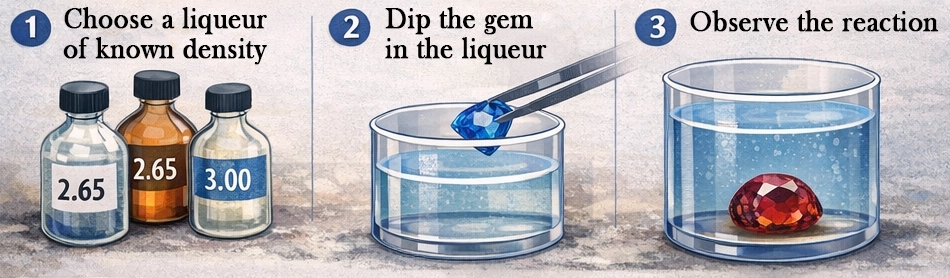
The use of heavy liquids follows a simple procedure. The gemologist begins by selecting a liquid of known density, such as a standard solution calibrated to 2.65 or 3.00. The gem, which has been cleaned beforehand to prevent any interference from dust or grease, is then gently placed in the liquid. Careful observation of its behavior then allows the gemologist to determine whether its density is lower, higher, or close to that of the solution.
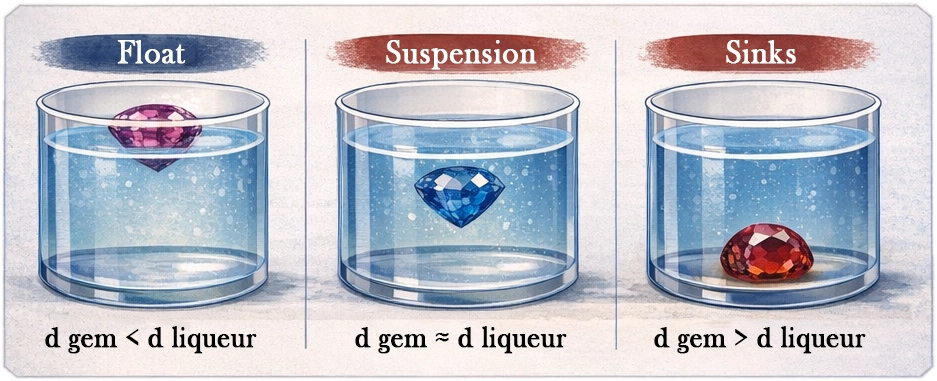
If the gem floats, it means its density is lower than that of the liquid. Conversely, if it sinks, its density is higher than that of the liquid. In some cases, the stone may remain suspended in the liquid, indicating that its density is close to or equal to that of the liquid.
This information can then be compared to the characteristic densities of various gemstones to aid in their identification.
The interest of the method in gemmology
This method is of particular interest in gemmology because it allows for a quick estimate of a stone’s density without requiring complex equipment. It is therefore a practical tool for distinguishing between certain gemstones that may look similar but have significantly different densities. Observing buoyancy in a calibrated solution can thus provide valuable insight into the identification process.
Limitations of the technique
However, this technique also has certain limitations. The accuracy achieved is lower than that provided by density measurement using a hydrostatic balance, which allows for a more precise determination of specific gravity. Furthermore, some stones may react unpredictably in the liquid, particularly if they are porous, cracked, or have undergone treatments that could alter their behavior in the solution.
To summarize
Thus, density solutions provide a simple and useful tool for estimating the density of gemstones. Based on the principle of floatability in a liquid of known density, this method allows for a quick comparison of a stone’s density and aids in its identification, while serving as a complement to other, more precise gemmological techniques.