
What is light?
Definition
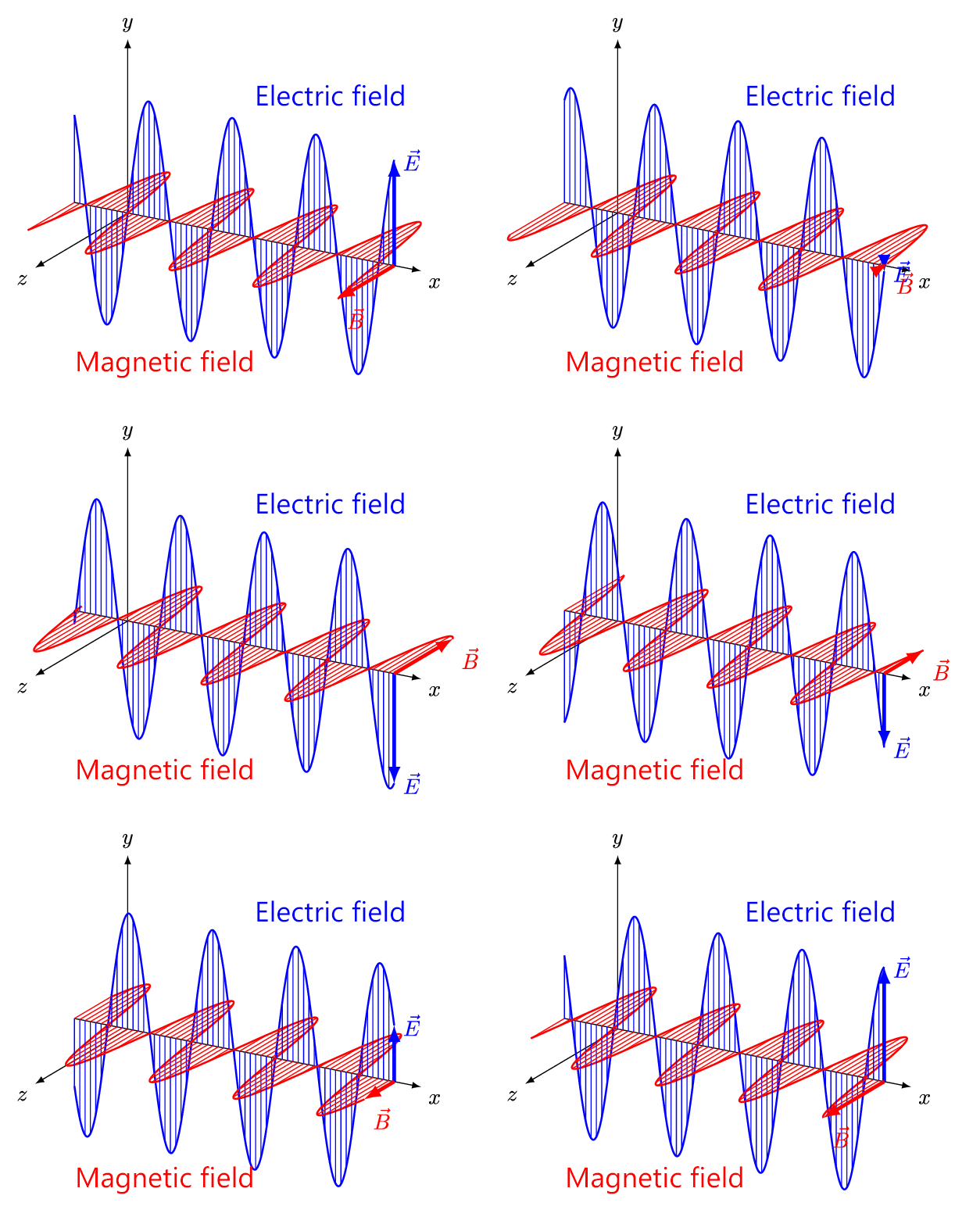
Light is a form of energy that propagates in the form of waves composed of oscillating electric and magnetic fields. This phenomenon is referred to as ‘electromagnetic radiation/waves’ because these two fields are closely linked and interact with each other. These waves, which travel transversely through space, can also be described as a stream of photons, particles that carry this energy.
Light belongs to the electromagnetic spectrum, which ranges from radio waves to gamma rays. Visible light, on the other hand, corresponds to the part of this spectrum that the human eye is capable of perceiving. It is also called the visible spectrum or optical spectrum, and ranges from wavelengths of approximately 380 to 780 nm.
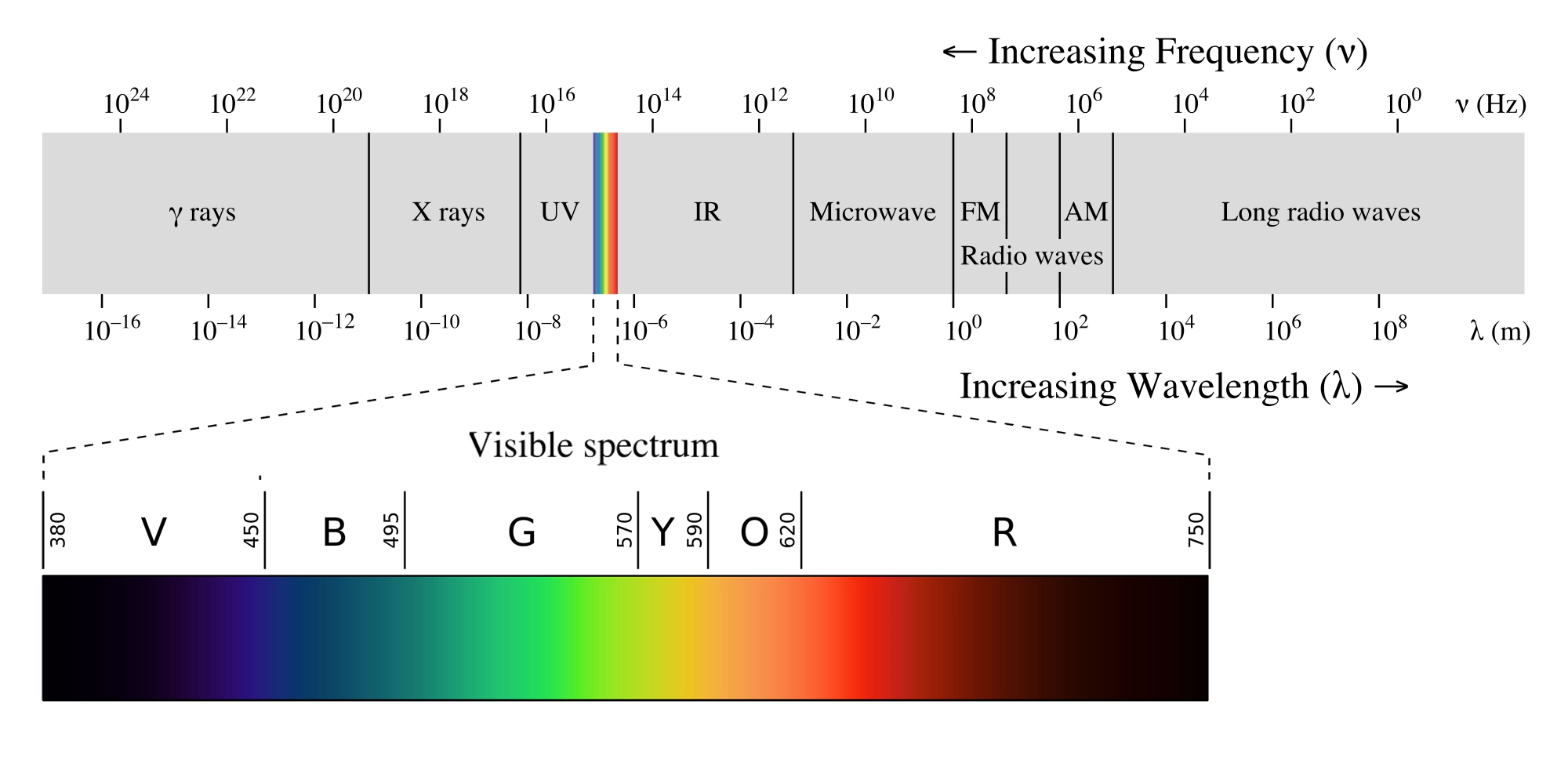
© Philip Ronan, Gringer, CC BY-SA 3.0, via Wikimedia Commons
From a fundamental point of view:
– It propagates in a vacuum at a speed of c=299,792,458 m/s
– It exhibits wave-particle duality: wave description (frequency, wavelength, polarisation) particle description (photons of energy E=hν, where E is the energy of the particle in joules, h is Planck’s constant, with an energy of 6.63 × 10⁻³⁴ J·s, and ν is the frequency in Hz)
– Its interaction with matter manifests itself through phenomena such as absorption, emission, diffusion, refraction and reflection.
Light and gems
In gemmology, light is essential for revealing a stone’s characteristics. A gemstone does not produce its own colour. It owes its colour to the interactions between light and its internal structure. When a ray of light enters a gemstone, several physical phenomena can occur simultaneously:
- Reflection: some of the light is reflected back to the surface of the stone, contributing to its brilliance.
- Refraction: light changes direction as it enters the gem. This phenomenon depends on the refractive index of each mineral.
- Dispersion : certaines longueurs d’onde sont déviées plus que d’autres, ce qui décompose la lumière blanche en couleurs visibles (effet appelé « feu », particulièrement marqué dans le diamant).
- Selective absorption: certain chemical elements present in the crystal structure absorb specific wavelengths, which determines the colour observed (for example, traces of chromium give rubies their red colour).
- Transmission or diffusion: depending on its purity and structure, a stone can allow light to pass through transparently, translucently, or diffuse it.
The crystal structure also plays an essential role. In certain minerals, light does not propagate in the same way depending on the direction of observation, which can produce pleochroism (color variation depending on the angle). Other gems exhibit particular optical phenomena related to their internal structure, such as iridescence or color play.
Thus, the appearance of a gemstone (its color, its dispersion, its brilliance, its transparency, etc.) derives directly from the physical laws that govern light and its interaction with matter. Understanding the nature of light therefore makes it possible not only to scientifically explain the beauty of gemstones, but also to interpret the optical phenomena that they present. These properties moreover constitute essential criteria for the identification and study of gemstones.
To summarize
Light is an electromagnetic wave that travels through a void at a speed of c = 299,792,458 m/s. It is characterized by a wavelength and a frequency. The portion of light perceptible to the human eye is called the visible spectrum (from 380 nm to 780 nm). In physics, light can also be considered as a flux of photons (energy particles), which illustrates its dual wave-particle nature. It helps explain the visual appearance of gemstones and plays an essential role in their identification.