
What is a critical angle in gemmology?
Definition
A critical angle is the angle of incidence at which light is completely refracted by a material. For a gemstone, this means that incident light will not be reflected by the pavilion but will escape through it, resulting in a loss of brilliance.
Critical angle and Gems
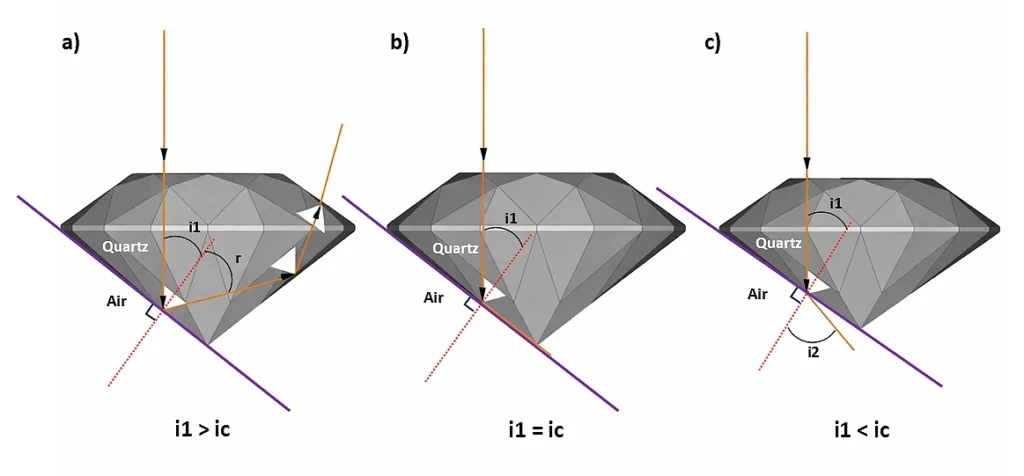
Figure a):
The angle of incidence of light (denoted i1) on an internal facet of the crown is greater than the critical angle. In this case, the light is reflected within the stone and travels back toward the crown, contributing to the gem’s brilliance.
Figure b):
The angle of incidence is exactly equal to the critical angle. The light then travels along the interface between the two environments (the gem and the air). This situation corresponds to a limiting condition between outward refraction and internal reflection.
Figure c):
The angle of incidence is less than the critical angle. The light then passes through the gem-air interface and escapes through the crown. This loss of light reduces the gem’s brilliance and creates an effect of excessive transparency known as the “window effect” when the cut is inadequate.
Determining the critical angle of a material
The calculation of the critical angle depends on the refractive index of the gemstone and that of the environment in which it is found (usually air). It is expressed using the following equation: sin ic = n2/n1
In this formula, ic represents the critical angle, n1 the refractive index of the gem, and n2 that of the external environment. In practical gemmology, since light generally passes from a gemstone into air, the refractive index of the second environment is approximately equal to 1. The relationship then becomes: ic = sin⁻¹ (1/n1). Thus, the higher the refractive index of a gemstone, the smaller its critical angle.
For quartz, which has an average refractive index of approximately 1.54, the critical angle is thus close to 40.5°. This value means that any light striking an internal facet of the crown at an angle less than this value will exit the gem (Figure c)) rather than being reflected within it (Figure a)).
Limitations and Summary
We can therefore conclude that the critical angle is a fundamental concept for understanding how light behaves within a gemstone and for determining the cutting angles that promote internal reflection. It explains why some gemstones retain light better than others, depending on their refractive index.
However, in practice, a stone’s visual appearance does not depend solely on this parameter. The gem’s movement, the presence of multiple rows of facets in the pavilion and crown, as well as material-specific optical properties such as birefringence, also influence the path of light. The critical angle should therefore be considered an essential theoretical benchmark, but one that is not sufficient on its own to fully explain a gem’s brilliance.